

Proven to Boost Teacher Retention
and Well-Being, and Child Growth
The Creative Curriculum Implementation and Ecosystem Engagement (CCIEE) Study is an independent, randomized controlled trial (RCT) that was recently conducted by the National Institute for Early Education Research (NIEER) at Rutgers University. Consistent results were achieved across public schools and private child care centers when preschool classrooms implemented The Creative Curriculum with our GOLD assessment and professional development solutions.

Teacher Retention Rate Increased by 59%
Across schools and child care centers in both districts, the use of our integrated curriculum, assessment, and professional development ecosystem increased the teacher retention rate by 59%.
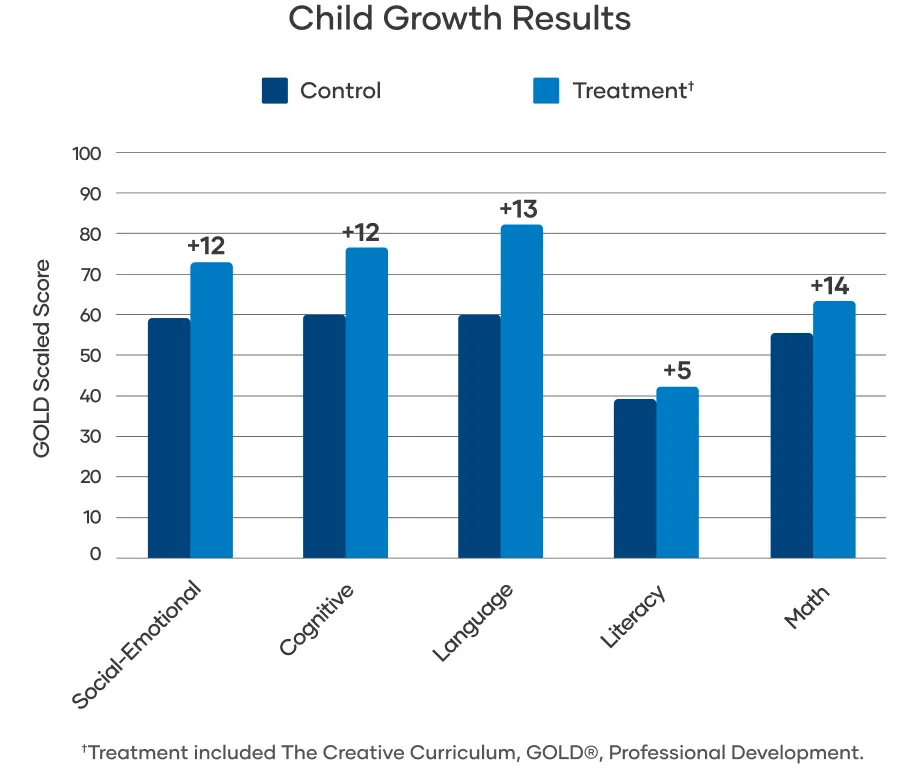
Child Growth Increased Across ALL Domains
Across programs in both districts, GOLD assessment data showed significant increases in growth data for ALL learning domains (social–emotional, language, cognitive, literacy, and mathematics).
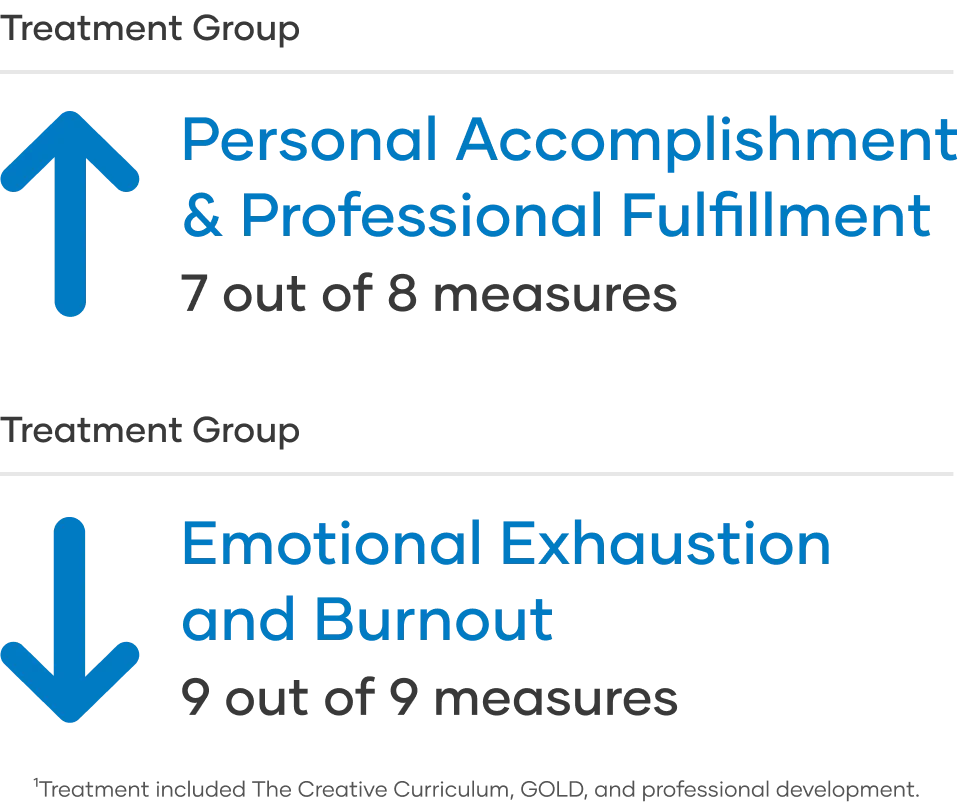
Teacher Well-Being Increased Across Key Measures
Teachers in the treatment group reported significantly higher levels of personal accomplishment—feeling more energized, exhilarated by their work with students, and professionally effective —while also experiencing lower levels of workday exhaustion and burnout.
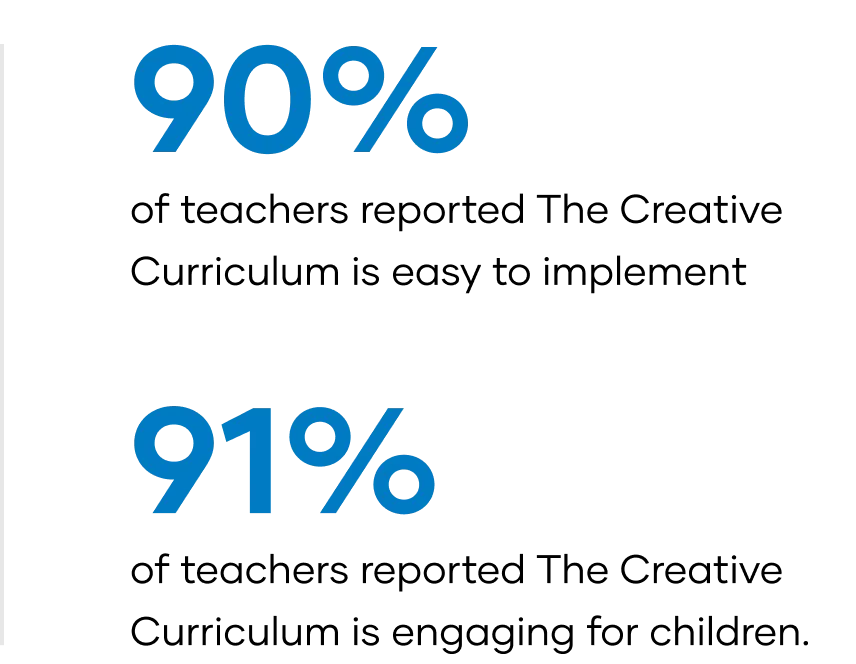
Curriculum Rated Engaging and Easy to Implement
In follow-up surveys, teachers were asked about The Creative Curriculum implementation and their perceptions of how it meets the needs of their students. Overwhelmingly, teachers agreed the curriculum is easy to implement (90%) and engaging for children (91%).
Solutions Featured in the
NIEER Study

 Build confidence, creativity, and critical thinking skills with the leading research- and play-based whole-child early childhood curriculum.

 Drive differentiated instruction without disruption by embedding authentic, observation-based assessment into each part of your day.

 Achieve fidelity and support teacher retention and satisfaction with access to flexible online learning and a community of 100K+ educators.
Frequently Asked Questions
The Creative Curriculum Implementation and Ecosystem Engagement (CCIEE) Study is an independent, randomized controlled trial conducted by the National Institute for Early Education Research (NIEER) at Rutgers University – one of the nation’s leading early childhood research institutions.
The CCIEE study used a cluster-randomized design across two New Jersey state-funded preschool districts that included both public and private programs. Coaches and teachers were randomly assigned to a treatment or control group.
The CCIEE study sought to answer the question “Does implementing The Creative Curriculum® within a fully connected ecosystem—including aligned live professional development and coaching, plus asynchronous, on-demand courses—produce measurable improvements in teacher outcomes, classroom practice, and children’s development?
The study was conducted independently by the National Institute for Early Education Research (NIEER) at Rutgers University – not by Teaching Strategies itself. NIEER is one of the nation’s foremost early childhood education research centers and has been conducting independent, policy-relevant research since 1988.
The full report is authored by Nores, M., Harmeyer, E., and Barnett, W.S. (2026) and published by the National Institute for Early Education Research at Rutgers University: Teaching Strategies’ Creative Curriculum Implementation and Ecosystem Engagement Study (CCIEE). Research Report. New Brunswick, NJ: National Institute for Early Education Research.
The study included 720 children across 180 classrooms over three years in two districts, spanning both public schools and private child care centers – making the findings applicable across the full range of early childhood program types.
It is a randomized controlled trial – the highest standard of educational research evidence – conducted by an independent research institution, NIEER at Rutgers University, across both public school districts and private child care centers.
A randomized controlled trial is a research design in which participants are randomly assigned to either a treatment group or a control group, so that any differences in outcomes can be attributed to the intervention itself rather than to pre-existing differences between groups. It is widely regarded as the gold standard for establishing cause and effect, and is the highest standard of educational research evidence. The CCIEE study used a cluster-randomized design which reflects how professional development is actually delivered in real district settings. Because assignment was random, the study can credibly link the Teaching Strategies ecosystem – The Creative Curriculum with aligned professional development, coaching, and GOLD assessment – to the outcomes observed, rather than to differences that existed before the study began. This is what distinguishes the CCIEE findings from the observational or correlational research that makes up most curriculum studies, and it is the basis for the study’s ESSA Tier 1 designation.
The CCIEE study used a cluster-randomized design across two New Jersey state-funded preschool districts that included both public and private programs. Coaches and teachers were randomly assigned to a treatment or control group.
Treatment: Teachers implementing The Creative Curriculum® and using the full Teaching Strategies® ecosystem had access to synchronous (live) virtual and asynchronous (on-demand) professional development aligned with the Teaching Strategies® ecosystem, plus ongoing coaching supports, and the GOLD® assessment system.
Control: The control group had business-as-usual access to The Creative Curriculum® and may or may not have had access to or used the digital tools. All the control group users also used GOLD® as the assessment tool.
Teacher retention was tracked across the3-year study period, and child outcomes were measured via growth (GOLD®) and via pre-post external assessments in year 3 (Fall 2023–Spring 2024).
The CCIEE study stands apart from most curriculum research because it used an independent randomized controlled trial—the highest standard of educational evidence—rather than observational or correlational methods. It evaluated a fully integrated early learning ecosystem in authentic public and private preschool settings over three years and produced evidence that meets the requirements for ESSA Tier 1 Strong Evidence.
ESSA Tier 1 is the highest level of evidence recognized under the Every Student Succeeds Act, reserved for findings from well-designed randomized controlled trials showing statistically significant positive effects. Programs seeking federal funding for curriculum decisions are increasingly required to demonstrate Tier 1 evidence backing.
The Every Student Succeeds Act defines four levels of evidence for educational programs:
-
- Tier 1 (Strong Evidence) requires a well-designed randomized controlled trial showing statistically significant positive effects — the same standard used in medical research.
- Tier 2 (Moderate Evidence) requires a quasi-experimental study.
- Tier 3 (Promising Evidence) requires a correlational study with statistical controls.
- Tier 4 is the lowest level, requiring only a logic model or research-based rationale.
Programs seeking federal funding – including Title I, Title II, Preschool Development Grants, and Head Start – are increasingly expected to demonstrate Tier 1 or Tier 2 evidence. The Teaching Strategies ecosystem is backed by ESSA Tier 1 Strong Evidence from an independent randomized controlled trial conducted by NIEER at Rutgers University.
Yes. Under ESSA, districts and programs using federal funds — including Title I, Title II, Preschool Development Grants, and Head Start — are required to select programs backed by strong evidence where available. Tier 1 Strong Evidence is the highest designation and provides the clearest justification for curriculum investment decisions to school boards, state education agencies, and federal auditors.

Drive Success for Your Educators, Children and Program
See the difference our proven ecosystem can make. Talk to a Teaching Strategies expert today.