How to Use These Checklists

Grounded in science of reading research, these checklists describe activities, learning experiences, and classroom conditions that are proven to promote progress toward important language and literacy goals. If your program serves children who are multilingual learners, pay special attention to strategies marked with an asterisk.

Oral Language Development

How are teachers helping children listen to and understand increasingly complex oral language?

Look for ways that children are...

  • offered daily opportunities to ask and answer questions about interesting classroom materials as they explore them firsthand.
  • responding to both open-ended and close-ended questions.
  • participating in daily discussions that address multiple content areas (e.g., math, science, social studies).
  • engaging in book discussions related to daily read-alouds.
  • building vocabulary related to their work and play, intentionally introduced and reinforced by the teacher.
  • playing games and singing songs that involve following verbal directions (e.g., “Simon Says,” “Hokey Pokey”).
  • encouraged to talk about what they are working on and learning about at school, including describing physical artifacts of their work and how they created them.
  • talking with adults and peers as they participate in process-oriented, large- or small-group activities (e.g., creating a class mural, cooking, building, carrying out assigned class jobs).
  • offered opportunities to interact one-on-one with adults in the classroom if they are reluctant to speak in a group.
  • offered a variety of classroom areas and times of day to engage in pretend play (e.g., Dramatic Play area, Block area, Library area).
  • offered a variety of visual supports, including photographs and other realistic images (as opposed to illustrations), props, body language, or gestures, to reinforce oral language learning. *
  • conversing with other children and adults in their first language(s). *

How are teachers helping children use language to express thoughts and needs?

Look for ways that children are...

  • offered many opportunities to hear and use oral language (e.g., read-alouds, conversations, introduction of vocabulary related to study topics and materials). 
  • participating in large-group discussions related to specific topics.
  • invited to speak during large-group time to describe processes and artifacts of their work and play. 
  • talking with adults and peers as they work in teacher-selected small groups. 
  • talking as they work and play collaboratively with self-selected small groups of peers.
  • encouraged to discuss their feelings and perspectives.
  • responding to a question of the day, which may be fact-based or opinion-based. 
  • responding to adults’ open-ended questions about their work, play, interactions, and feelings.
  • participating in oral storytelling and story retelling activities.
  • offered opportunities to look at and discuss wordless picture books.
  • able to describe the class rules and why they are important to self and others.
  • encouraged to express themselves in the language with which they are most comfortable. *
  • (in a dual-language or multilingual learner setting) playfully practicing using a new language as they develop skills and confidence. * *

How are teachers helping children engage in reciprocal conversations with adults and peers?

Look for ways that children are...

  • greeted warmly when they arrive at school each day and hearing their names as pronounced by their family. *
  • offered many opportunities throughout the day to converse with adults and peers. *
  • engaging in spontaneous conversations with peers during their work and play as well as during unstructured times (e.g., snack and mealtimes). *
  • engaging in spontaneous conversations with familiar adults in the classroom, during their work and play as well as during unstructured times (e.g., snack and mealtimes).
  • aware of how to invite others to work and play with them.
  • aware of how to ask others if they may join them in their work or play.
  • offered guidance in the language(s) they use in the classroom to help them learn how to join conversations. *

Literacy Learning

How are teachers helping children develop phonological awareness, phonics, and word recognition skills?

Look for ways that children are...

  • participating in developmentally appropriate activities that play with language, such as singing, chanting, and rhyming games. 
  • playing games that help them break sentences into words and words into syllables.
  • playing games, singing songs, and hearing books read aloud that help build early letter-sound correspondence. 
  • playing games, singing songs, and hearing books and stories read aloud that focus on alliteration (e.g., tongue twisters).
  • engaging in daily shared writing experiences.
  • offered rhyming and poetry books in the classroom Library area.
  • offered books throughout the classroom that are written in their first language(s). * 
  • listening to read-alouds that occasionally include rhyming books and poetry. * 
  • offered opportunities to hear and participate in read-alouds in their first language(s). * 
  • actively involved with creating a sound wall that they can reference as needed.
  • offered learning experiences that support literacy learning in their first language(s), including using songs, books, chants, and rhymes in the first language(s). * 

How are teachers helping children develop alphabet knowledge?

Look for ways that children are...

  • playing games and singing songs that teach the alphabet. * 
  • engaging in read-alouds that occasionally include alphabet books. 
  • offered access to alphabet books in the classroom Library area.
  • playing with toys, games, and puzzles related to the alphabet. 
  • offered easy visual access to an alphabet strip posted at eye level.
  • offered small versions of an alphabet strip that they can reference while writing.  * 

How are teachers helping children demonstrate knowledge of print and its uses?

Look for ways that children are...

  • seeing meaningful environmental print posted in the classroom, including their first names in multiple places (e.g., to label cubbies, hooks in the coat closet, their work).
  • referring to relevant print materials during their pretend play (e.g., menus or shopping lists in the Dramatic Play area, maps in the Block area).
  • writing their first names on a daily sign-in page or chart.
  • writing their first names on their artwork and other artifacts of their work and play.
  • responding to a written question of the day.
  • participating in shared writing experiences in both large- and small-group settings.
  • offered print materials and writing experiences in their first language(s). *

How are teachers helping children comprehend and respond to books and other texts?

Look for ways that children are...

  • exposed to a variety of developmentally appropriate texts, including children’s fiction, children’s nonfiction, poetry, concept books (e.g., alphabet, numbers, colors, shapes), and magazines.
  • have access to print resources to enhance their pretend play (e.g., menus, lists, signage).
  • engaged in multiple read-aloud experiences each day, including repeated read-alouds of children’s books with complex plots and interesting characters who encounter and solve social problems.
  • offered opportunities to respond to books and stories before, during, and after reading.
  • offered opportunities to discuss new vocabulary presented in books and stories.
  • involved in discussions about how print functions (e.g., an author writes the words and an illustrator draws the pictures, books are read front to back, print is read left to right).
  • able to easily view a version of the daily schedule that uses both words and pictures to convey meaning. *
  • able to easily access a variety of books in a classroom Library area, which have been displayed with their covers visible to aid in book selection.
  • guided to make connections between prior learning and new information presented in books and stories.
  • offered a variety of ways to retell stories (e.g., props, pictures, puppets). *
  • provided with reading experiences, books, and other texts in their first languages(s) to support their language development and literacy learning in their first language(s), while acquiring English language skills. *

How are teachers helping children develop early writing skills?

Look for ways that children are...

  • provided accurate models of how to write their first names.
  • offered a variety of writing materials they can easily access independently throughout the classroom.
  • occasionally offered specific opportunities to write outdoors.
  • given authentic reasons to write during their work and play (e.g., labeling their work, creating signs, lists, or labels to support their pretend play).
  • engaged in shared writings where the teacher uses self-talk to describe what they’re thinking and doing as they write.
  • encouraged to use writing to correspond with others (e.g., message board, greeting cards, thank you notes).

Why These Checklists Matter

Research on children’s language development and early literacy learning demonstrates that children build these skills through rich, joyful, everyday experiences that are delivered in ways that children learn best and in environments that help them feel welcomed, valued, and capable.

The items on these checklists are both developmentally appropriate for children in pre-K and grounded in the science of reading. Leaders can use the checklists to help them recognize the many ways teachers are promoting the language and literacy skills that will prepare children for kindergarten. They can also reference the checklists to help determine which curriculum and assessment resources will best support teachers in carrying out this essential work.

Put These Checklists to Work in Your Program
Download the Checklists

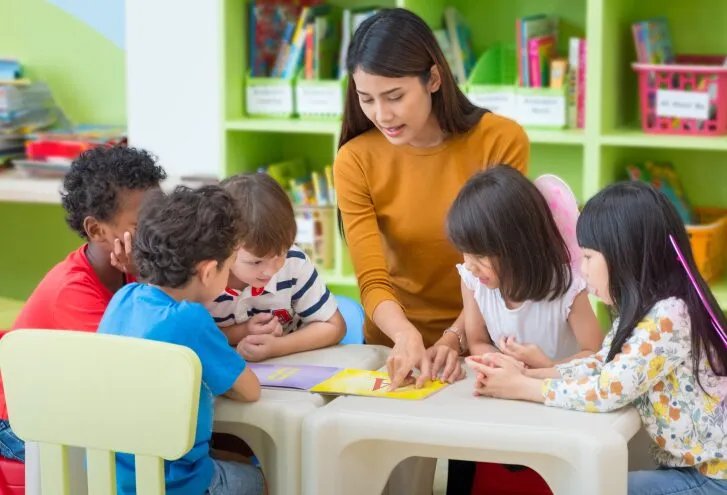
Print or share these Kindergarten Readiness checklists to help guide program planning, classroom set-up, and conversations with preschool and pre-K teachers.
Download PDF 

Explore Aligned Curricula

With The Creative Curriculum for Pre-K and Kickstart Literacy, pair an evidence-based pre-K curriculum with daily instruction in the kind of language-rich, play-based experiences these checklists describe.
Explore The Creative Curriculum
Explore Kickstart Literacy

Track Children’s Growth

Assess each child’s progress and 
see where individual support may be needed with GOLDFinch, which combines formative assessment with a literacy screener designed explicitly for 4- and 5-
year-old children.

Explore GOLDFinch