Kickstart Literacy: Six Tips for Successful Implementation

Why Kickstart Literacy?
The body of research known as the science of reading, which explains how children learn to read and spell, offers a great deal of insight into how to conduct effective reading instruction. This research makes clear that the time before kindergarten is critical for building literacy skills and that a child’s journey toward reading proficiency must begin long before the third-grade test.
Findings from the science of reading are often summarized under umbrella areas that have become known as “the five pillars of literacy.” These are
- phonemic awareness,
- phonics and word recognition,
- fluency,
- vocabulary, and
- comprehension.
Early childhood educators are not surprised by these findings. Indeed, they know well that a comprehensive, well-planned, and effective early childhood curriculum will address all of these areas through a balance of teacher-led instruction and child-centered practice and discovery, all within an environment that is intentionally warm and welcoming. Such a curriculum will play out each day through various developmentally appropriate means, such as
- read-alouds and book discussions;
- teacher-led shared writings that build word knowledge and print awareness;
- investigations that present authentic reasons to promote children’s pre-writing skills;
- plentiful opportunities for discussion and conversation;
- hands-on engagement with interesting materials, which builds vocabulary, content knowledge, and cognitive skills;
- songs, games, chants, and rhymes that play with language; and
- guidance and resources for meaningfully engaging families in their children’s learning.
What has been surprising in the science of reading research, however, are the findings related to the long-term benefits of additional daily, direct instruction that
- buttresses oral language development;
- strengthens the bridge from oral language to written knowledge through phonemic awareness activities; and
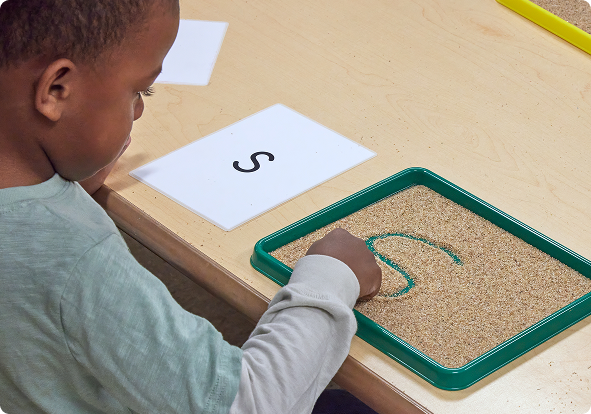
- targets early phonics skills, including instruction that simultaneously introduces a letter of the alphabet, the sound it most often spells, and its correct, efficient written form.
Kickstart Literacy was created to fill this need.
Kickstart Literacy is a supplemental early literacy curriculum designed to promote children’s understanding and skills related to phonological awareness (including rhyming, alliteration, and segmenting and blending words and sounds), the alphabet, letter–sound correspondence, and writing.
Here are six tips for helping you make the most of Kickstart Literacy. Whether you are an administrator or coach working with teachers who are implementing these resources or a teacher who’s using them in your preschool or pre-K classroom, following these suggestions will help ensure children are successful.
Six Tips for Implementing Kickstart Literacy
- Follow the lesson guidance closely to maintain its intention without expanding its scope.
Each of the 180 daily lessons that comprise Kickstart Literacy has three parts, which are to be implemented in the order they are presented in the two-page lesson guidance.
Each lesson begins with a brief reminder and reinforcement of the prior day’s instruction. It is followed immediately by an introduction to the current day’s important concept along with some guided practice related to that concept. Many teachers will find that these first two parts can take place in a large-group setting, such as during the regularly scheduled morning meeting.
The final part of each day’s lesson—Independent Discovery—gives children a chance to practice applying the day’s instructional focus on their own through a developmentally appropriate activity.
While The Creative Curriculum is designed to be flexible and responsive to a particular class or school community and encourages teachers to “make the curriculum their own,” Kickstart Literacy lessons are sequenced according to findings from the science of reading. Take the topics of segmenting and blending, for example. In Kickstart Literacy, children are first introduced to segmenting sentences into words, before they work on segmenting and blending syllables.
Finally, during the last six weeks of the school year, they are introduced to segmenting and blending onset and rime. This is the sequence that the science of reading research suggests is most helpful for building these skills. The lessons in Kickstart Literacy are to be followed closely in order, as written, without embellishment or extra activities that can easily alter the point of the lesson and add extra time to it—which leads to our second tip.
-
Pay attention to the amount of time you spend on lessons.
Kickstart Literacy lessons are intended to be short and focused. This is intentional, as teacher-led, direct instruction can easily become counterproductive when children are asked to attend for a longer period of time than they are developmentally ready to. Without meaning to, you can dilute the power of a lesson if you spend more time on it than necessary. This is particularly noticeable at the beginning of the year or when children are working in a large group, but it is also true when you are working with just a few children at a time.
By keeping the time that you spend on Kickstart Literacy short and focused, you can lead the first two parts of the lesson (Playful Practice and Guided Discovery) in a large-group gathering without making that time overly demanding for children.
Then, you can set up and introduce the Independent Discovery part of the lesson later in the day. If you offer a modified choice time during your daily small-group time focused on language and literacy, this is a perfect opportunity for Kickstart Literacy Independent Discovery activities.
-
Honor children’s developmental levels.
Kickstart Literacy is intended to be implemented with children during the school year just prior to their attending kindergarten. Young children tend to change and grow rapidly, and the development and learning of those who are four years old is typically quite different from those who are three. Kickstart Literacy was designed to meet a specific set of needs at a specific point in a child’s journey of literacy learning.
If you are using Kickstart Literacy in a mixed-age preschool classroom—where some of the children will attend kindergarten next year and some will receive another year of preschool education—plan to separate the children during your Kickstart Literacy lessons so that you are addressing only those children for whom these lessons are most appropriate.
Next year, when your current three-year-olds are four and in line to attend kindergarten the following year, then they can be the ones who benefit from the many ways that Kickstart Literacy will prepare them for the formal reading instruction offered in elementary school.
-
Observe during both Guided and Independent Discovery times to determine whether one or more children need additional instruction or support.
Providing the correct extra support for children who need it means that they are better able to understand and participate in your large-group instruction (Playful Practice and Guided Discovery) each day. Consult the Skill Development Cards for specific activities you can use when meeting one-on-one with any child who needs extra support. Lead these activities in a quiet location, so that you and the child can easily interact and hear each other.
Skill Development Cards are divided by skill category. Check out the free, downloadable version of a one-page Kickstart Literacy scope and sequence chart that also displays the corresponding alphanumeric code for Skill Development Cards.
-
Always read ahead a few lessons to make sure you have gathered the necessary materials in advance of needing them.
Both the Guided Discovery and Independent Discovery parts of a lesson can call for specific materials. It can help you to know in advance what materials you’re going to need for upcoming instruction and practice.
Many lessons ask you to use certain materials from around your classroom—such as items with names that rhyme or that begin with a particular phoneme. There’s great value in couching new instruction in materials and vocabulary that are already familiar to children. But it can take a bit of thought and time to make sure you’ve considered all the possible choices from among your classroom materials.
So always read ahead a few lessons, especially if you’re new to Kickstart Literacy. Your future self will thank you.
-
Remember the other “pillars of literacy.”
We began this post with an acknowledgement of the fact that Kickstart Literacy intentionally addresses very specific instructional goals, which the science of reading has identified as a necessary part of an extensive root system of foundational skills.
In terms of the 38 objectives for development and learning, nearly 97% of the lessons in Kickstart Literacy intentionally nurture skills related to Objectives 15 and 16.
It’s essential, however, that in our desire to foster these skills we don’t inadvertently neglect others.
-
- Children still need ready access to a wide variety of texts, including hearing and engaging in discussions of rich, interesting literature.
- They still need to see meaningful, helpful environmental print.
- They still need plenty of opportunities and reasons to converse with both adults and peers.
- They still need encouragement and support to write for a variety of reasons, both as individuals and as participants in large- and small-group shared writings.
- They still need instruction in and reinforcement of vocabulary related to interesting materials and learning experiences.
- They still need plenty of opportunities to play with language through songs, chants, rhymes, games, and fingerplays.
- They still need to see themselves as capable learners and communicators with thoughts, ideas, and opinions worth sharing.
Your daily read-alouds, songs and rhymes, games that play with words and sounds, conversations, discussions, and shared writing, as well as the books, other texts, and writing materials that children can easily access on their own, are all still huge and necessary contributors to children’s language development and literacy learning.
Fitting It All In
Ensuring that every child can enter kindergarten fully prepared to make the most of what it has to offer will require a comprehensive curriculum that addresses all five pillars of literacy through a whole-child approach, as well as supplemental resources that focus specifically on building children’s phonemic awareness, early phonics, and early writing skills.
The preschool/pre-K schedule is busy. Fitting in all that needs to be done in a day can take some careful planning. The tips we’ve identified here can help with that.
About the Author
Beth White is senior manager of Educational Content at Teaching Strategies and a writer on our education team. She creates content for videos, presentations, professional development, e-books, blogs, and other projects.
Beth is a former classroom teacher and elementary school principal. She served on the executive staff at the National Association of Elementary School Principals and dedicated several years to designing early childhood education apps and games for handheld digital devices before joining the education team at Teaching Strategies in July 2017.
Beth holds a bachelor’s degree in history and a master’s degree in elementary education, both from the University of Virginia. She completed coursework for an EdD in education policy and leadership at the University of Delaware.
Fun Fact: Beth shares a birthday with Oscar the Grouch.

Build Strong Literacy Foundations With Confidence
Discover how Kickstart Literacy provides focused, research-based instruction that strengthens phonological awareness, phonics, and early writing while fitting seamlessly into your daily classroom routine.
Frequently Asked Questions
Yes. Kickstart Literacy is designed as a supplemental early literacy curriculum that complements a comprehensive pre-K curriculum. It provides focused, daily instruction in phonological awareness, phonics, alphabet knowledge, letter-sound correspondence, and early writing while allowing teachers to continue delivering rich, whole-child learning experiences through their core curriculum.
Kickstart Literacy is designed to be easy to implement using its structured daily lessons and instructional guidance. Programs can further strengthen implementation through professional learning and coaching that helps educators deliver instruction with confidence and fidelity.
Kickstart Literacy is intended for children in the preschool year immediately before kindergarten. In mixed-age classrooms, teachers may choose to implement lessons with children who will enter kindergarten the following year while providing other developmentally appropriate learning experiences for younger children.
Kickstart Literacy builds foundational skills in phonological awareness, phonics, alphabet knowledge, and early writing that prepare children for formal reading instruction in kindergarten. When paired with a comprehensive early childhood curriculum, it helps children develop the literacy foundations they need for future success.
Yes. Kickstart Literacy provides a consistent instructional framework that administrators and coaches can use to support implementation, observe classroom practice, and provide targeted feedback. This shared approach helps promote consistent, high-quality literacy instruction across classrooms.