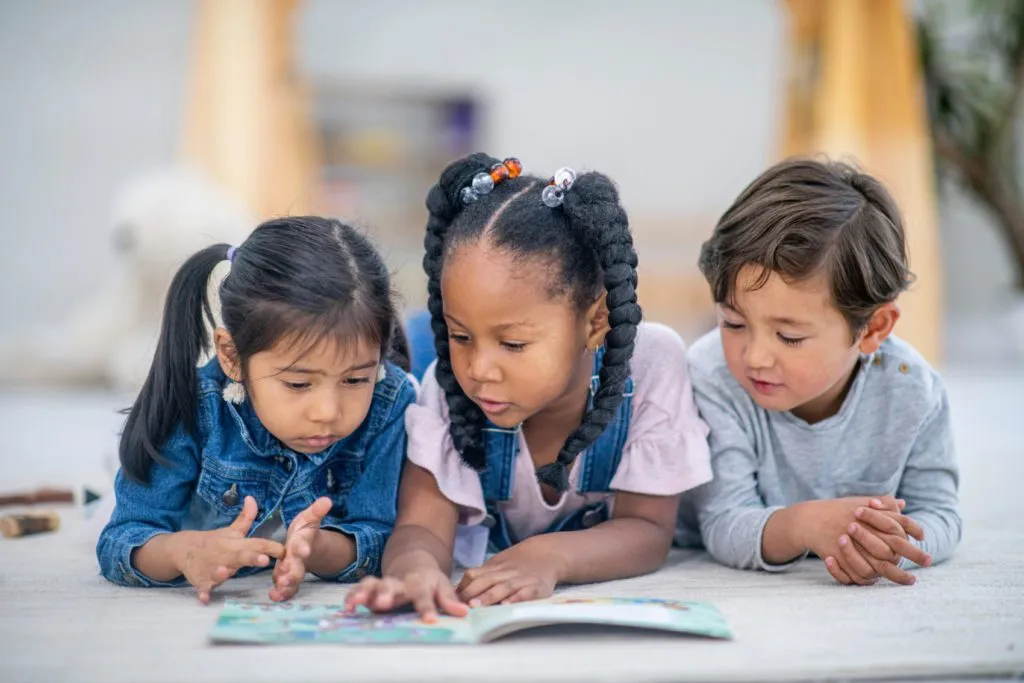
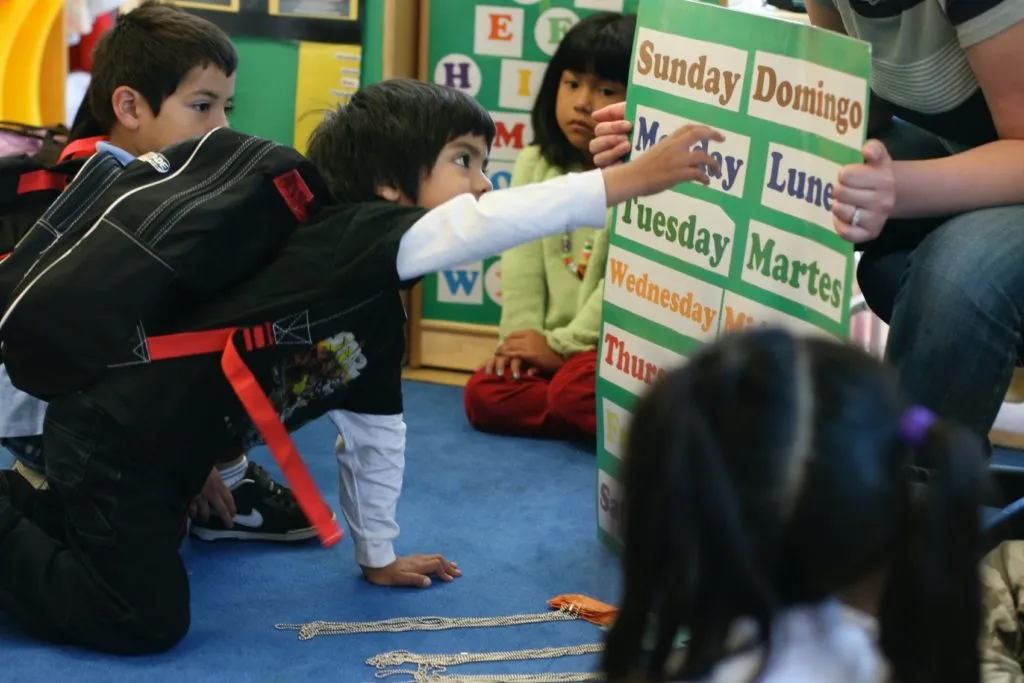
Building High-Quality Bilingual Early Childhood Programs
Summary of Insights
High-quality bilingual education creates one connected learning experience rather than duplicating lessons across languages. A shared curriculum, intentional instruction, and teacher collaboration can help children develop language skills at the same time as they learn important concept knowledge.
- A shared curriculum ensures consistent learning goals across languages without repeating instruction.
- Intentional language bridging builds vocabulary and connects new learning to existing knowledge.
- Teacher collaboration creates meaningful language experiences through play, exploration, and conversation.
- Authentic assessment across languages helps educators understand children’s abilities and individualize instruction.
Walk into bilingual early childhood classrooms around the world and you’ll see incredible diversity. In one school, children are learning Japanese and English. In another, Arabic and English are woven throughout the day. Elsewhere, children are developing literacy in Spanish and English, French and Arabic, Portuguese and English, or Mandarin and English. Every community has its own languages, culture, history, and educational goals.
Yet regardless of the languages being spoken, I hear many of the same questions from teachers and school leaders.
“Should every lesson be taught in both languages?”
“How do classroom teachers and language teachers work together?”
“How can we help children become bilingual without creating two completely separate programs?”
These are important questions, because high-quality bilingual education is about much more than learning two languages. It is about intentionally designing one coherent learning journey that helps children become bilingual, biliterate, and culturally responsive while developing deep conceptual understanding across all areas of learning.
One of the biggest misconceptions I encounter is that bilingual education means teaching everything twice. In actuality, the strongest bilingual programs are intentionally coordinated, not duplicated. Children do not need two separate learning experiences: they need connected experiences in which each language contributes something meaningful to their understanding, communication, and identity. This approach reflects decades of research demonstrating that children transfer conceptual knowledge and many literacy skills across languages, allowing educators to build upon what children already know rather than reteaching every experience.
Start with learning, not language
One of the most powerful shifts a bilingual program can make is changing the first question educators ask.
Instead of asking, “What should we teach in Language A, and what should we teach in Language B?” begin by asking, “What are children learning?”
When teachers start with shared concepts, meaningful investigations, and developmental objectives, language becomes the vehicle for learning rather than the destination.
Imagine a child who understands the concept of a triangle. Whether that child later learns the word triangle, triángulo, 三角形, or مثلث the concept has already been constructed. The child’s task is not to relearn the mathematical idea, but to connect new vocabulary to existing understanding and then use that language in meaningful conversations, investigations, and play.
This is intentional language bridging. It is very different from simply translating the same lesson.
One curriculum provides a shared foundation
When everyone begins with the same curriculum and shared developmental goals, planning becomes collaborative rather than parallel, and children experience continuity rather than repetition.
Schools sometimes assume that each language requires its own curriculum. While well intentioned, this often leads to duplicated lessons, fragmented planning, inconsistent expectations, and unnecessary work for teachers.
Instead, one shared curriculum can provide the common foundation for everyone supporting children’s learning.
Teachers work toward the same developmental objectives, explore the same studies or investigations, and document children’s progress using shared expectations. Each educator then intentionally contributes something unique through the language they are supporting.
The result is one connected learning journey in which each language expands children’s thinking in different, complementary ways.
Every language should add value
Recently, while working with a school in Colombia, the leadership team asked a question that many bilingual programs face.
They had English-language teachers who visited preschool classrooms throughout the day, but their schedules varied. Sometimes they joined during read-aloud. Other times they arrived during choice time, small groups, or another part of the daily routine.
Their question was simple: “What is the most effective way to use the time our English-language teachers are in the classroom, and what resources should they use?”
Rather than recommending a separate English curriculum or asking teachers to repeat activities that had already taken place, I encouraged them to think differently.
The classroom should continue following its regular daily schedule. The English-language teacher’s role is not to interrupt that learning. Instead, it is to intentionally extend it.
If the teacher joins the classroom during read-aloud, they might read the story in English, helping children connect familiar ideas with new vocabulary and opportunities for conversation.
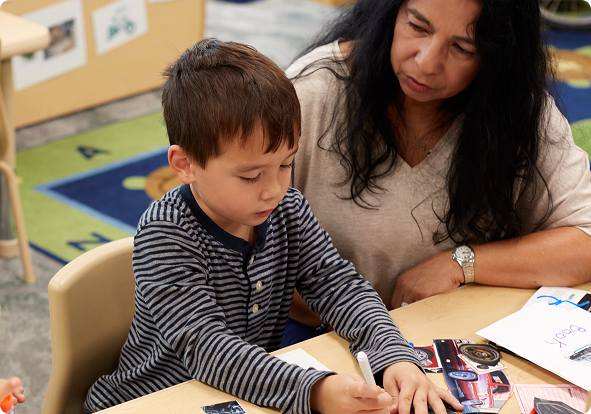
If they join during choice time, there is no need to pull children away from meaningful play for an isolated language lesson. Instead, they can join children’s investigations, ask thoughtful questions, model rich vocabulary, engage in authentic conversations, and document children’s development in English through GOLD observations.
If they are present during small-group instruction, they can facilitate that experience in English while working toward the same developmental objectives the classroom teacher is already supporting.
Notice what stays consistent: the curriculum, the developmental goals, and the children’s investigations. What changes is the language of the children’s experiences.
Instead of repeating learning, the language teacher enriches it. Children continue building the same concepts while expanding their ability to communicate, think, and participate across languages.
The same principle applies regardless of which languages your school uses. Whether a language teacher supports English, Spanish, Arabic, French, Mandarin, Portuguese, or another language, the goal is the same: join children’s ongoing learning; extend it through meaningful interactions; and help children build both language and understanding without creating a second, disconnected program.
Collaboration matters more than equal minutes
One of the questions schools ask most frequently is how much time children should spend in each language.
The answer depends on the goals of the program, the languages spoken in the community, staffing, family expectations, and many other factors. There is no single bilingual model that works for every school.
What matters most is not creating perfectly equal amounts of instructional time. What matters is ensuring that adults work together intentionally.
When teachers regularly discuss what children are investigating; which developmental objectives they are supporting; what concepts children are developing; which vocabulary will unlock learning; and how each educator will extend, rather than repeat, the experience, they create a much more cohesive program.
In many schools, 10 focused minutes of collaborative planning each week can prevent an entire week of duplicated instruction.
Protect rich language experiences
Another common misconception is that bilingual instruction requires constant switching between languages.
Strategic translation and occasional code-switching certainly have their place, especially when supporting understanding or building connections. However, they should not become the instructional model.
Children need uninterrupted opportunities to think, investigate, negotiate, question, and communicate in each language. Brief language bridges can connect existing knowledge to new vocabulary, but children also need sustained conversations that allow each language to develop naturally and authentically.
The goal is not choosing one language over another. It is valuing both languages enough to give each the time and space children need to become confident communicators.
Assess the child, not the language
Assessment presents one of the greatest opportunities in bilingual education for collecting observations of children’s learning in different contexts. But it is important to remember that a child’s ability to express an idea in one language at a particular moment does not necessarily reflect what that child understands.
Young multilingual learners demonstrate their knowledge in many ways, such as through actions, gestures, problem-solving, drawings, conversations with peers, and communication in either of their languages.
When classroom teachers and language teachers contribute observations from different contexts, educators can develop a more complete understanding of each child’s development. Rather than asking, “Can this child do it in this language?” we should ask, “What does this child know, understand, and communicate across all of their learning experiences?”
Documentation systems such as GOLD support this collaborative approach by bringing together authentic evidence from multiple educators and multiple contexts, allowing instructional decisions to reflect children’s true capabilities rather than the language they happened to be using in one moment.
Four questions every bilingual program should ask
Whether your school is developing bilingual learners in Colombia, Singapore, Canada, Brazil, the United Arab Emirates, the United States, or anywhere else in the world, these four questions can help strengthen your program.
- Where are we unintentionally repeating learning experiences?
- Where could we provide longer periods of sustained interaction in each language?
- Where could intentional language bridges deepen children’s understanding?
- How does each educator uniquely contribute to children’s learning instead of repeating what another adult has already taught?
These conversations often reveal that relatively small changes in planning can significantly improve children’s experiences.
One learning journey, two languages
High-quality bilingual education is not measured by how many times children hear the same lesson in different languages. Nor is it about prioritizing one language over another.
Instead, it is about helping children build strong concept knowledge while developing the ability to think, communicate, read, write, and learn across two languages.
When educators share developmental goals, coordinate instruction, intentionally bridge languages, and collaborate around authentic assessment, children experience something far more meaningful than duplicated lessons. They experience one connected learning journey where each language enriches the other; every educator contributes with purpose; and every child has the opportunity to become bilingual, biliterate, and prepared to thrive in an increasingly interconnected world.
But perhaps the greatest gift of bilingual education extends beyond language itself. Every new language opens another way of seeing the world. Children learn that ideas can be expressed in different ways, that cultures bring unique perspectives, and that communication begins with curiosity and respect. As they grow in two languages, they are also developing empathy, cognitive flexibility, confidence, and a stronger sense of identity and belonging. Those are qualities that will serve them well not only in school, but throughout their lives.
As educators, our goal is not to ask, “How can we teach this lesson twice?” Instead, we should ask, “How can each language uniquely contribute to children’s learning?”
When we begin with that question, our discussions move beyond translation. We create classrooms where languages complement one another, educators work as one team, and children experience the greatest promise of bilingual education: the opportunity to understand, communicate, and flourish across languages, cultures, and communities.
When we intentionally design one curriculum that comes to life through two languages, we create one coherent learning journey, one that prepares children not only for school, but for a lifetime of learning, belonging, and connection in a multilingual world.
About the Author
Suzana Spina is our dedicated director of International Partner Success at Teaching Strategies. With a global perspective and a genuine commitment to educational success, she is a dynamic leader dedicated to enhancing international partnerships and advancing effective teaching strategies worldwide.
Suzana started her career as a Spanish special education preschool teacher, where she developed a deep passion for fostering inclusive learning environments. She transitioned into roles as a coach and principal, ultimately serving as the director of a prominent suburban school district near Dallas, Texas.
Deeply committed to exploring global teaching methodologies, Suzana has a keen understanding of diverse cultures and believes that every educational encounter is enriched by the exchange of ideas and practices across borders. She is also a strong advocate for the power of play in education and tirelessly encourages educators to embrace creativity and joy in their teaching.
Build Stronger Bilingual Classrooms With
One Connected Curriculum
Discover how The Creative Curriculum supports meaningful learning across languages, helping educators align instruction, strengthen collaboration, and create engaging experiences that support every multilingual learner.
Frequently Asked Questions
Bilingual education is a broad term for instructional approaches that use two languages to support children’s learning. Dual-language education is a specific approach that intentionally develops proficiency and literacy in two languages over time. Both approaches can help children strengthen language skills, cultural awareness, and academic understanding, although program goals and instructional models may differ.
Children can begin learning two languages from infancy. Early childhood is an especially valuable time for language development because young children naturally learn through relationships, conversations, play, and everyday experiences. Providing meaningful exposure to both languages during these formative years can help establish a strong foundation for bilingualism and biliteracy.
No. Research indicates that learning two languages does not cause speech or language delays. Bilingual children may distribute their vocabulary across languages or combine words from both languages as they develop communication skills. These are typical aspects of multilingual development and should not be automatically interpreted as signs of a delay.
Families can support bilingual development by speaking, reading, singing, storytelling, and playing with children in the languages they know best. Encouraging children to communicate with family members in their home languages helps strengthen relationships, cultural identity, and language development. Families do not need to be fluent in both languages used at school to contribute meaningfully to their children’s bilingual learning.
Schools can evaluate bilingual program success by examining children’s language development, conceptual understanding, engagement, and progress toward developmental objectives. Educator collaboration, family feedback, and authentic assessment can also provide valuable insights. Rather than measuring success solely through vocabulary acquisition or language proficiency, leaders should consider how effectively the program supports children’s overall learning, confidence, and ability to communicate across languages.
Teachers benefit from ongoing professional learning focused on multilingual language development, culturally responsive teaching, language scaffolding, authentic assessment, and effective collaboration. Coaching and opportunities to observe successful bilingual practices can help educators apply these strategies consistently. Professional development should also address how to adapt instructional experiences to children’s individual language backgrounds and developmental needs.