Designing Pre-K as Its Own Year: What School Leaders Should Know

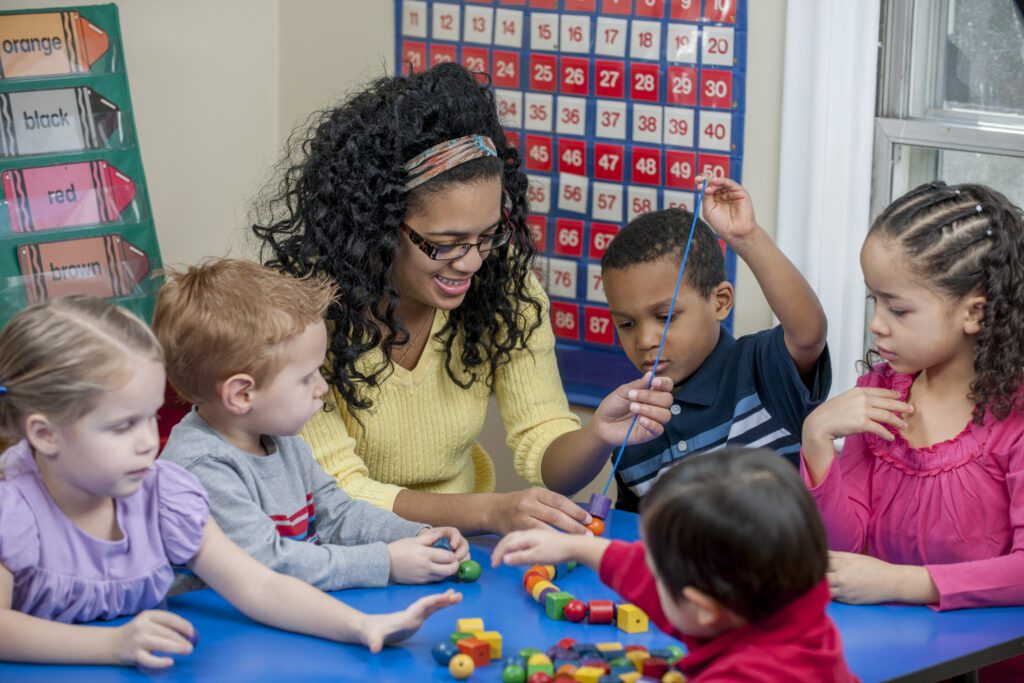
During my years of working with children, I was fortunate enough to teach children of several different age-groups and grade levels, experiences I wouldn’t trade for anything. But I must admit that I did develop a favorite: pre-K.
So, Just What Is Pre-K?
Regardless of what the year before kindergarten is called where you live (transitional kindergarten, TK, VPK UPK, etc.), what I am referring to here as “pre-K” is the educational programming a child participates in the year before kindergarten. It’s a distinct, truly magical year, one where I often found the “a-ha!” moments to be as common as crayons, blocks, and picture books.
Pre-K is not kindergarten—which, despite its many changes over the years, is still the domain of 5-year-olds—but it’s also not 3-year-old preschool. Four-year-olds, in that year before kindergarten, learn in ways that are fundamentally different from older children, and they need a program intentionally designed to reflect their developmental stages.
- Pre-K is a critical period for promoting school readiness (specifically kindergarten readiness) that, when done well, can make a profound lifelong difference in a child’s view of school, their understanding of the roles that teachers play in their lives, and their sense of themselves as capable learners.
- Pre-K is a year of rapid growth in self-regulation, language, social–emotional skills, and problem-solving. The skills associated with kindergarten readiness are end-of-year goals. Children do not need to arrive with these skills. Pre-K is where they develop them.
- A high-quality pre-K curriculum must be developmentally appropriate and intentionally designed for 4-year-olds.
- When leaders design pre-K as its own year, children experience smoother transitions to kindergarten and stronger long-term outcomes.
What Makes Pre-K Special?
To understand what makes the pre-K experience special, we must first look at what makes 4-year-olds special.
A year—even a typical 9- or 10-month school year—is a long time when you’ve been on the Earth for only about 48 months. It seems short-sighted to assume that what a 4-year-old is capable of, the ways they see the world, the size of their vocabulary, and even the sheer volume of what they have encountered will be the same as that of a kindergarten student, who has about 20% more life experience.
Pre-K is a year of rapid growth across all domains of development and learning. Any adult working with children during this time will note significant gains in self-regulation, both small- and large-muscle strength and coordination, expressive and receptive language, and social problem-solving ability.
Four-year-olds learn through exploration, play, language-rich interactions, and meaningful relationships.
Here are some key developmental characteristics of pre-K learners.
- Children practice self-regulation skills through routines, peer interactions, and role play.
- They build early language and literacy foundations through conversations, storytelling, and exposure to print.
- Their problem-solving ability grows as they experiment, ask questions, and make choices.
- Social–emotional skills strengthen as they navigate friendships, manage emotions, and collaborate.
- Curiosity drives learning, and play provides the ideal context for building knowledge and skills.
Because of these unique developmental characteristics, it has been so exciting to see school district leaders and early childhood program directors across the country prioritizing resources developed specifically to meet the needs of 4-year-olds, by leveraging the unique strengths and interests that children demonstrate during the year before kindergarten.
Research from the Harvard Center on the Developing Child notes that early childhood is a critical period for developing executive function skills¹. These are built through active, hands-on experiences that align with the developmental needs of 4-year-olds. Additionally, high-quality pre-K programs are linked to improved long-term outcomes, including higher graduation rates and stronger academic performance and gains in language, literacy, and math that persist into later grades². Leaders who prioritize the importance of a developmentally appropriate and intentionally designed pre-K program are better positioned to ensure equitable learning experiences and long-term positive outcomes.
Why Pre-K Isn’t Kindergarten
The year a child spends in pre-K has the potential to play a unique and powerful role in their development and learning. But positive change doesn’t happen on its own.
Pre-K experiences are most effective when intentionally designed to align with the ways 4-year-olds learn best. If, instead, these children are offered a watered-down kindergarten curriculum, delivered through traditional elementary school instructional strategies, they are apt to miss essential opportunities to develop the knowledge, skills, and abilities that matter most at this age.
Imagine watching a football game. The quarterback, hoping to score a touchdown, throws the ball into the end zone. Makes sense, right? But what if the receiver is nowhere near the endzone? Why didn’t the quarterback toss the ball to where the receiver was? Education is sometimes like this, tossing instruction to where we want a child to end up rather than where the child is actually waiting to receive it. And nowhere is this clearer than in attempting to use next year’s curriculum with this year’s children.
When pre-K is modeled too closely after kindergarten-level expectations, several risks emerge.
Risks of Using Developmentally Inappropriate Curriculum in Pre-K
- Frustration: Frustration is common in classrooms where teachers begin the year with unrealistic assumptions about what children know and can do. This is demoralizing for children and can cause significant negative impact on their life-long positive approaches to learning. To avoid frustration, make sure your pre-K curriculum is grounded in developmentally appropriate expectations.
- Boredom: For young children, “boredom” doesn’t typically come from being presented with material they have already mastered but rather from being offered activities that don’t spark their sense of joy, curiosity, or critical thinking. To combat boredom, make sure your pre-K curriculum offers learning experiences that are play-based and interesting to children.
- Challenging behavior: The appropriateness of children’s behavior is often inversely proportional to the appropriateness of the learning experiences, meaning children are most likely to make “good choices” when they find the experiences they have to choose from are interesting to them and offer frequent opportunities to achieve success, a key driver of motivation. To curb challenging behaviors, make sure your pre-K curriculum offers children reasons to want to participate in classroom activities.
- Low levels of engagement: Children can “tune out” when they are offered experiences and materials that are either too simplistic or too difficult. Once you know what deep engagement looks like, it can be easy to spot superficial means of engagement—such as completing worksheets or responding to flashcard drills or jumping through other hoops on a teacher’s checklist. To keep children engaged, make sure your pre-K curriculum describes the experiences, suggests the materials, and builds in the time for children to deeply engage with their ideas, questions, and inventions.
Finding the Right Curriculum for Pre-K
It becomes essential, then, that anyone hoping to make the most of the pre-K year delivers the right kinds of instruction, with the right kinds of strategies, that meet children where they are.
Here are several key developmental characteristics of children in pre-K (as described in the foundation volumes of The Creative Curriculum) that should influence your decisions when looking for the best curriculum for this important year.
- Four-year-olds demonstrate growing social–emotional development (but they are still only four).
Four-year-olds are a wonderful mix of independence and sociability. They like doing things on their own. They take great pride in imitating adult behaviors, which you will see in their pretend play. They also tend to love working and playing with other children, especially in groups of two or three. Sharing becomes easier, and they are better able to manage classroom rules, routines, and transitions. Whether playing alone or in a group, 4-year-olds tend to be very expressive, using actions and facial expressions as well as words to convey messages. - They demonstrate greater physical strength and coordination (but they are still only four).
Four-year-olds are increasingly able to control their muscles and will begin demonstrating increasingly complex, coordinated movements. For example, most 3-year-olds go down steps by putting both feet on the same step before continuing down, but most 4-year-olds can easily alternate feet. The leg muscles of a 4-year-old enable them to maintain a rhythmic stride when running. They tend to play enthusiastically on slides, swings, and other outdoor equipment. Their fine-motor coordination improves dramatically as well. On their own, they can wash their hands, button their coats, and use hook-and-loop fastener straps on shoes and jackets. Some are coordinated enough to cut intricate shapes with scissors, zip their coats, attempt to tie their shoes, and hold a pencil with a three-point finger grip. - Their receptive and expressive language skills balloon (but they are still only four).
Four-year-olds tend to develop language skills rapidly. They usually understand and use positional words such as in, by, with, to, over, and under. They love to talk, engage in conversation, and listen to books read aloud to them. Trying new words often delights 4-year-olds. They like using big words and enjoy their growing abilities to communicate with others, which is enhanced by a growing ability to pronounce longer words and speak in longer sentences. - Their cognitive development strengthens (but they are not yet five).
Changes in cognitive skills such as persistence, attention, inventive thinking, problem solving, and deep engagement in interesting tasks are among the most exciting developments for 4-year-olds. Four-year-olds are eager scientists, artists, and musicians. They are extremely curious about cause and effect and want to know why things happen. They demonstrate growing abilities to plan and pursue a variety of appropriately challenging tasks, meaning they are better able to use choice time wisely and work independently. They approach the world with great curiosity and use their experiences to understand it. However, because separating reality from fantasy is still hard for them, they sometimes harbor irrational fears. Suddenly, the closet might be home to an unwelcome monster. They might also tell what many adults describe as lies. For example, after knocking over a glass of milk, a child might insist that she did not do so, truly believing that what happened was beyond her control and that speaking of an alternate reality will make it so. Developmentally, 4-year-olds struggle with the differences between truth and fiction, but they don’t do so with malice.
What This Means for the Pre-K Teacher
All these changes combine to make being “four” a special time in the life of a child. Pre-K teachers can leverage understanding of these changes—and the developmentally appropriate expectations for what 4-year-olds typically know and can do—to craft learning experiences tailored especially for them.
All children learn by doing, by experiencing the world around them and using their senses to attach new information to current understandings. For 4-year-olds, this can mean offering
- materials that appeal to their interests and ability levels (e.g., activities that take advantage of their growing small-muscle strength and coordination, like taking photos with a camera);
- greater independence during choice time, supported by simple reminders (e.g., 3-step instruction cards that use words and pictures to remind children how to play a board game or draw and write in their journals);
- extended opportunities for carefully observing materials such as items from nature, along with invitations to document what they see by creating observational drawings; and
- daily small-group, focused instruction in both math and language and literacy, followed by opportunities for independent practice of newly introduced skills.
Developing Kindergarten Readiness
The children who show up at the beginning of the pre-K year will be more like 3-year-old preschool children than kindergarten students. The job of the pre-K teacher is to gently move them toward kindergarten readiness by the end of their year together.
If we ask children in pre-K to “perform” like kindergarten students right out of the gate, we are not setting anyone up for success. Here at Teaching Strategies, we designed The Creative Curriculum for Pre-K to meet children where they are and then gradually guide them to where they need to be to have success in kindergarten.
Yes, part of the job of pre-K is to help each child develop kindergarten readiness. The other part is to create a place—and offer the experiences—that will welcome, honor, celebrate, and embrace each child, just as they currently are. And I can tell you from experience that’s a pretty wonderful place to be.
About the Author
As our senior vice president of Educational Content at Teaching Strategies, Breeyn Mack oversees the instructional design of educational resources and professional development initiatives that support early childhood educators and families.
Breeyn is a well-known and highly regarded speaker and author whose background in education—as a preschool teacher and program director and as a public school teacher serving second- and fifth-grade inclusion classrooms—gives her deep insight into the challenges, opportunities, and obstacles that educators face every day.
In her almost 10 years at Teaching Strategies, Breeyn has collaborated with early childhood educators in the field to create innovative, high-quality, and developmentally appropriate curriculum, assessment, and professional development materials to support teachers, including coauthoring Coaching to Fidelity, Preschool Edition.
Fun Fact: Breeyn is also the mother of Lucy, whose time in elementary school gives Breeyn yet another window into the joys of nurturing young learners.

Explore The Creative Curriculum for Pre-K
Support a pre-K year that is developmentally appropriate, intentionally designed, and
grounded in research.
Frequently Asked Questions
Pre-K focuses on foundational skills that develop through play, exploration, and social interaction. Kindergarten includes more formal instruction. Instructional models from kindergarten are not developmentally appropriate for 4-year-olds.
During the pre-K year, children build essential skills in self-regulation, language, social–emotional development, and executive function. These skills predict early academic success and long-term outcomes.
Misalignment can reduce engagement, limit exploration, increase behavioral challenges, and suppress skill development in areas that matter most during early childhood.
A curriculum should be intentionally designed for pre-K learners, support whole-child development, emphasize play and inquiry, and align with developmentally appropriate practice.
It is built specifically for four-year-olds and supports whole-child development, executive function, inquiry, and language-rich learning experiences.
References
- Center on the Developing Child at Harvard University. (2011). Building the brain’s “air traffic control” system: How early experiences shape the development of executive function.
- Barnett, W. S., Jung, K., Friedman-Krauss, A., Frede, E., Gómez, R. E., & Alan, J. A. (2018). Abbott Preschool Program longitudinal effects study. National Institute for Early Education Research.