Looking for GOLD to meet your KEA needs?
Formative Assessment Made Easy
for Teachers
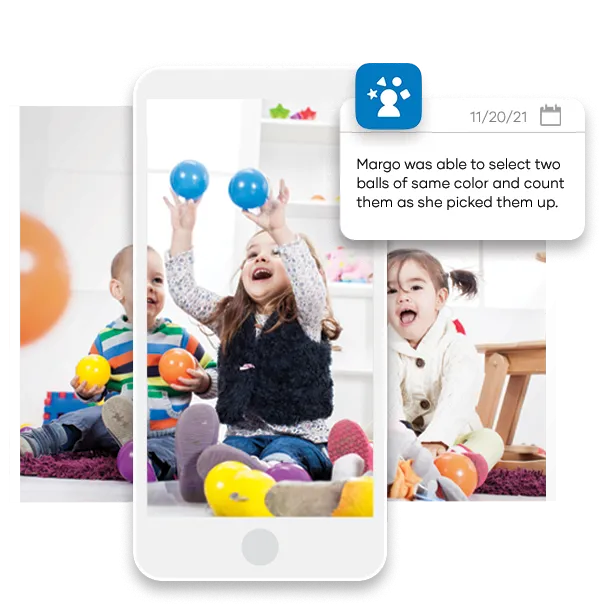
Capture Observations in the Moment
With GOLD, assessment is an authentic part of instruction, not a disruption. Embedded in your everyday interactions with children in the classroom or at home, formative assessment is an effortless, organic part of your teaching day. You can easily capture, organize, and store notes, photos, videos, and digital samples of children’s work in the moment to make observations authentic, objective, and easy to remember.

Understand Each Child’s Needs Based on Developmentally Appropriate Milestones
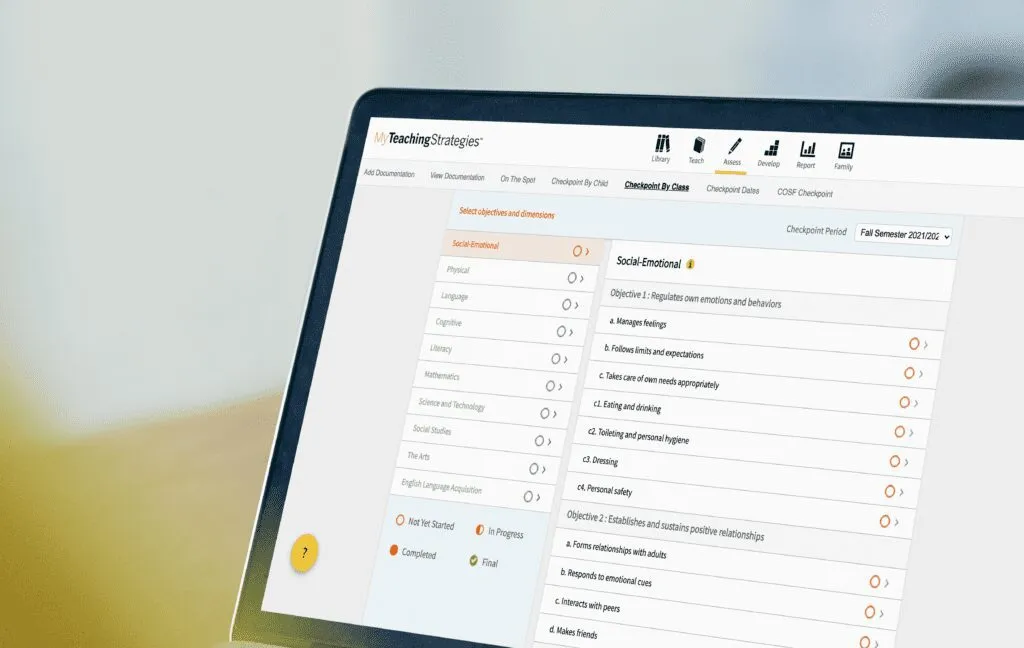
The assessment model used in GOLD follows widely held expectations for children from birth through third grade and enables a whole-child approach to assessment. Color-coded progressions guide teachers toward selecting and adapting activities that support each child’s development and learning, including those with disabilities. Meaningful reports inform classroom practices and individualized instruction.

Connect the Dots Between Curriculum and Assessment
Automatically connect assessment data and observation capabilities with daily instructional resources, creating an instantaneous and ongoing feedback loop of information to individualize learning and empower teachers to capture observations in the moment.

Strengthen Family Partnerships
Engage family members with family observations, family-facing learning resources, and two-way communication. Teachers can seamlessly integrate family observations into their documentation to inform checkpoint ratings, whether in a traditional classroom or distance learning setting.
GOLD helps us to also look at each child as a whole. We really like the reports. They are parent-friendly and make it easy to show where their child is and where we want to see them by the end of year. GOLD is very easy to use and doesn’t take a ton of time.
Heather McGraw
PreK Teacher, Acadia Academy
Lewiston, Maine
Formative Assessment Made Powerful
for Administrators

Aligned to Your Early Learning Standards
GOLD aligns to early learning guidelines in each state and the Head Start Early Learning Outcomes Framework, so you can demonstrate that your program is meeting all requirements while focusing on the needs of each individual child.

Data-Driven Decisions in Real Time
GOLD provides administrators with the data they need for real-time reporting and large-scale, programmatic decision-making. Easily manage and maintain users, classes, and child records and generate outcomes reports.

Reliably Administer Valid Assessment
Rigorously and regularly tested, GOLD yields reliable, valid, and culturally sensitive information. With Interrater Reliability Certification for teachers, administrators can ensure a valid and reliable assessment process at scale.
Research-Based
GOLD is research-based, validated, and shown to be effective
by extensive independent research.



Sharpen Your Assessment Skills
Powerful professional development options are available to enhance your GOLD efficacy and boost learning outcomes.
Featured Resources



Frequently Asked Questions
GOLD, also known as TS GOLD, is an online, research-based observational assessment system for children from birth through third grade. Rather than pulling children aside for formal testing, teachers document authentic observations — photos, notes, videos, and work samples — during everyday classroom activities and rate children’s progress against research-based objectives and developmental progressions. GOLD generates reporting that informs both individual instruction and program-level decision-making, and produces family-facing reports that translate assessment data into plain language.
Most assessment tools are built for a single grade band. GOLD uses a single developmental language and a continuous progression from infancy through third grade, so a child’s growth story does not reset when they move from an infant-toddler program to pre-K, or from pre-K to kindergarten. For districts running mixed-delivery systems — Head Start, state pre-K, and K-3 in the same community — this continuity is what makes cross-setting data actually comparable and useful for system-level decisions. The birth through third grade progressions also allows for teachers to individualize instruction for the children in their classroom, regardless of the knowledge, skills, and abilities that the child knows and can do.
GOLD generates class-level and individual data that maps to MTSS frameworks. Checkpoint reports show which children are performing below, at, or above widely held expectations, allowing teachers and coaches to identify who needs Tier 2 or Tier 3 support before a formal referral. This checkpoint data gives instructional leaders what they need to allocate intervention resources early and monitor progress as support is put in place.
Yes. GOLD is aligned to the Head Start Early Learning Outcomes Framework (ELOF) and to early learning standards in all 50 states, as well as an increasing amount of international standards. GOLD is an approved or required assessment tool in many state-funded pre-K systems. For districts and grantees navigating ESSA accountability requirements, GOLD’s data on kindergarten readiness and P-3 outcomes can inform both program quality reporting and early literacy decision-making.
GOLD is designed to embed assessment into the normal flow of the day rather than adding a separate documentation task. Teachers can capture notes, photos, videos, and digital work samples in the moment using the GOLD Documentation App, and observation data connects automatically to daily instructional resources, creating an ongoing feedback loop that supports individualized learning without disrupting instruction. Family observations can also feed directly into checkpoint ratings, so teachers aren’t the only ones generating evidence. Programs typically pair GOLD with professional development and coaching to help teachers build efficient, targeted observation habits — Teaching Strategies offers PD specifically aimed at strengthening GOLD practice over time.
Unlike assessments that are primarily used to generate a data point, GOLD is built to run through the full instructional cycle: teachers document authentic observations during everyday activities, rate children’s progress against research-based objectives and progressions from birth through third grade, and use that data to plan differentiated, individualized instruction. GOLD also generates reporting for both classroom and program-level use – including the Class Profile Report and Individual Child Report for teachers, and family-facing reports like the Growth Report and Report Card that translate checkpoint data into plain language. That combination — assessment, instructional guidance, and family communication in one connected system – is what GOLD emphasizes as its differentiator from more narrowly scoped assessment tools.
Yes. GOLD is used across the full range of early learning settings – Infants, Toddlers & Twos, Preschool, Pre-K, Head Start, Family Child Care, Private Child Care, and Grades 1–3 – and spans public school districts, Head Start grantees, and private centers alike. For private centers that aren’t driven by Head Start or state mandates, the value tends to center on family communication quality, teacher professional growth, and having credible assessment data to support enrollment conversations and accreditation. GOLD also aligns to each state’s early learning standards and the Head Start Early Learning Outcomes Framework, and licensing scales from single classrooms to large multi-site programs.
Yes. GOLD is widely used as a kindergarten entry assessment (KEA) tool in states that require or recommend an observational measure at school entry. Because GOLD follows children continuously from birth through third grade using the same developmental progressions, programs that use GOLD in pre-K arrive at kindergarten with a documented developmental history for each child — not just a snapshot. Kindergarten teachers receive that incoming data on day one, allowing them to begin differentiating instruction immediately rather than spending the first weeks of school re-assessing children from scratch. For states with formal KEA requirements, GOLD’s alignment to state early learning standards and the Head Start ELOF means the same tool satisfies both the pre-K assessment requirement and the kindergarten entry data collection — eliminating duplicate assessment and easing the pre-K to K transition for families, teachers, and administrators alike.
GOLD lets teachers embed assessment into the normal flow of the day instead of pulling children aside for testing. Using the GOLD Documentation App, teachers can capture notes, photos, videos, and digital work samples in the moment, and that observation data connects automatically to daily instructional resources, creating an ongoing feedback loop between assessment and instruction. Color-coded developmental progressions — covering birth through third grade — guide teachers toward activities appropriate to each child’s current level, including children with disabilities. Reports like the Class Profile Report and Individual Child Report translate that data into a clear picture of classroom and individual needs, so teachers can plan differentiated, intentional instruction. Families can also contribute observations directly into a teacher’s documentation, so teachers aren’t the sole source of evidence.
GOLD gives administrators real-time data for both individual-classroom oversight and large-scale programmatic decision-making. Administrators can manage users, classes, and child records across a program, and generate outcomes reports to track performance at the classroom, site, or program level. GOLD is aligned to each state’s early learning standards and the Head Start Early Learning Outcomes Framework, helping administrators demonstrate that their program is meeting requirements. Interrater Reliability Certification for teachers gives administrators a way to ensure assessment data stays valid and consistent across classrooms and staff, even at scale. Licensing scales from a handful of classrooms to large, multi-site programs.

Drive better learning outcomes.
Get GOLD today and begin using the most reliable and scalable formative assessment solution to inform your instruction and improve outcomes for the children in your classroom.